
Is Trump a Liar or a Cheat? Critics Can’t Make Up Their Minds
Many evils can be laid at the feet of social media, among them the stoking of envy, division, polarization, rage, depression, and the time simply wasted in endless doomscrolling. But there is one benefit of allowing the unwashed masses to costlessly broadcast their every thought, however inane: it provides a fascinating window into human psychology, and for those of us in the education and persuasion business, a useful insight into what can charitably be called the minds of others.
Author and political commentator Michael Malice is fond of pointing out that most people do not use a true/false filter to evaluate claims, but rather an us/them filter, meaning that whether a given proposition is accepted has more to do with the tribal loyalties of the speakers and listeners than with any objective appraisal of evidence. This is true enough as far as it goes, but I think it neglects the important role that stories play in our thought processes. Most of us have stories that run along in our heads, narratives we tell ourselves about how the world works. When we encounter a new fact, we check it against our internal stories to see if it fits. If it does, we incorporate the fact into our story. If it doesn’t, we tend to disregard or disbelieve it.
This is not news. The term “confirmation bias” is used to describe how people are more willing to seek out and accept information that supports what they already believe, and are more skeptical of things that point in the opposite direction. We usually don’t realize that we are doing this, but we are, and it’s something we are all susceptible to, even educated people who are well aware of the phenomenon.
Less frequently discussed, however, is what happens when a fact confirms one set of beliefs, but contradicts another. A moment’s thought will make it fairly obvious that we do not have just one story running through our heads, but many, and that sometimes these stories conflict with each other. How is the subconscious to cope with the cognitive dissonance that comes when two competing stories collide?
To answer that question, we need only look at the latest outrage perpetrated by everybody’s favorite supervilllain, Donald Trump. Prior to the USA’s crucial Round of 16 match against Belgium in the World Cup, Trump told a reporter that he asked the tournament’s organizing body, FIFA, to review a controversial suspension of one the American team’s best players. Had this suspension been allowed to stand, the US would have entered its next match at a distinct disadvantage. Ultimately, for reasons known only to themselves, FIFA opted to allow the suspended player, Folarin Balogun, to play.
This decision prompted outrage, with soccer fans from around the world taking to X to accuse the US of cheating, and that Trump’s influence resulted in preferential treatment for the country hosting the World Cup for the first time.
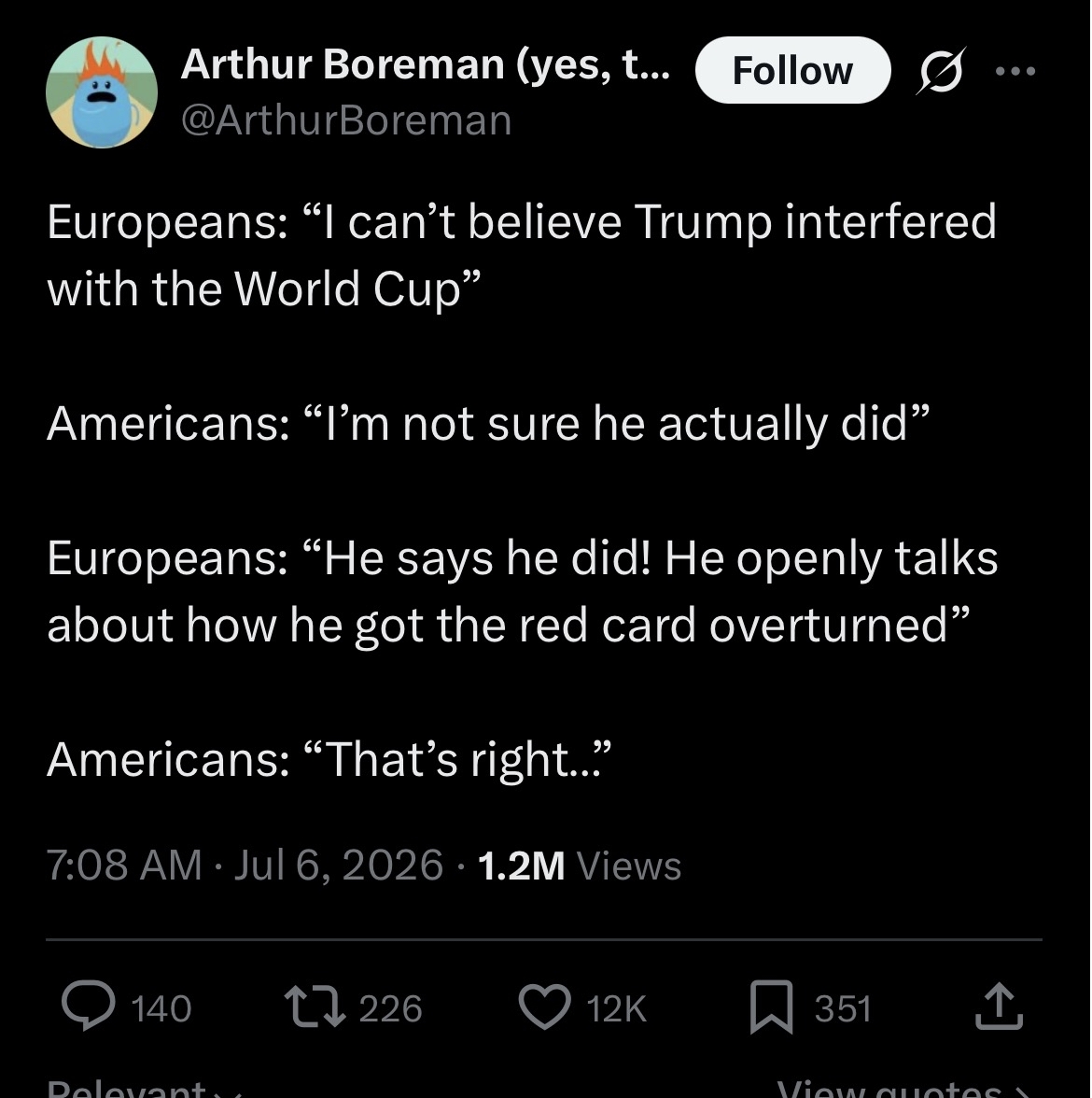
It’s hardly surprising that something Trump said should make everyone angry—that’s been the pattern for much of the last decade. But what is slightly odd is the apparent willingness to take him at his word. After all, Trump is widely known to be a braggart who can’t resist any opportunity to make grandiose claims about his own importance and influence. In 2018, Sam Harris, one of the President’s most outspoken critics, said that Trump “lies more than any person has ever lied in human history.” This claim, though hyperbolic and difficult to support empirically, seems to capture the feelings of many people around the world regarding the braggadocio of the 47th president.
So, if Trump always lies, why are people so quick to believe that he really did interfere with the World Cup, something that seems as unlikely as it is the kind of thing Trump would ordinarily lie about? The answer, I think, is that what we are witnessing is a hierarchy of stories people tell themselves, each one battling the others for supremacy. One story says that Trump is a compulsive liar, that you can’t believe a word he says, and that he has nothing but contempt for the truth. This is a powerful story for people who hate Trump because it casts him in a consistently bad light while allowing the easy dismissal of anything good he might have inadvertently accomplished during his time in office. If Trump says the economy is doing well, we know it must really be in trouble. If he says that we’re winning the war in Iran, we must actually be losing. Very convenient for those whose primary motivation is criticism rather than analysis.
However, there is another, even more powerful story that is especially persuasive to non-Americans such as the general audience for the World Cup. That story claims that America is an evil, corrupt, backwards, and stupid place that must always be in the wrong even when it isn’t. This story has been brought to the forefront of the European mind over the last month due to a confluence of factors. First, the World Cup being held on American soil proved particularly infuriating due to Americans’ historical indifference to the sport of soccer (I mean football! Sorry, Europe!) As well as their general ignorance regarding its rules and traditions. It’s understandable how a constant chorus of “what is the off sides rule? Oh, that’s stupid, they should change it” would be irritating to those for whom association football rises to the level of a national pastime.
This attitude of resentment has not been helped by the flood of World Cup tourists discovering firsthand that America is not such a bad place, and that the European media has been lying to them for decades about the arrogant, ignorant, gun-toting, obese yanks. For those lacking the means or inclination for international travel, this wave of positivity has only made them double down on their defensiveness about European superiority.
As if this wasn’t bad enough, The United States is also currently celebrating its 250th birthday, resulting in levels of public patriotism that the typical European finds gauche, jingoistic, and generally repulsive. All this is to say, this July has seen Europe sweltering not only under a blistering heat wave (for which they blame America) but also in a particularly crabby and anti-American mood.
So, then. The opportunity arose to accuse the USA of cheating at one of Europe’s most sacred traditions, and to personally blame Donald Trump for the wrongdoing, you can see how the temptation would be all but irresistible. The slightly less urgent belief that Trump is an inveterate liar, though not abandoned, was temporarily placed on the back burner in favor of a more satisfying narrative.
Personally, I suspect that Trump had nothing to do with the overturned penalty, and that his bragging about it is merely typical of his self-serving bluster. But it’s been fascinating to watch people who yesterday refused to believe a word the President said suddenly adamant that he would never lie about bullying FIFA into compliance.
If there’s a lesson here (something more broadly applicable than “Europeans hate America more than they distrust Trump”, it may be that the best way to reach people with new information is to present it in a way that not only fits in with their preconceived notions about the world, but which they can incorporate as a coherent part of their favorite and most cherished stories. If only we could find a way of demonstrating that the World Cup embodies capitalism, individualism, and freedom, we might make some progress with the soccer-obsessed rest of the world.
Free the People publishes opinion-based articles from contributing writers. The opinions and ideas expressed do not always reflect the opinions and ideas that Free the People endorses. We believe in free speech, and in providing a platform for open dialogue. Feel free to leave a comment.