Creative Destruction: Here It Comes Again
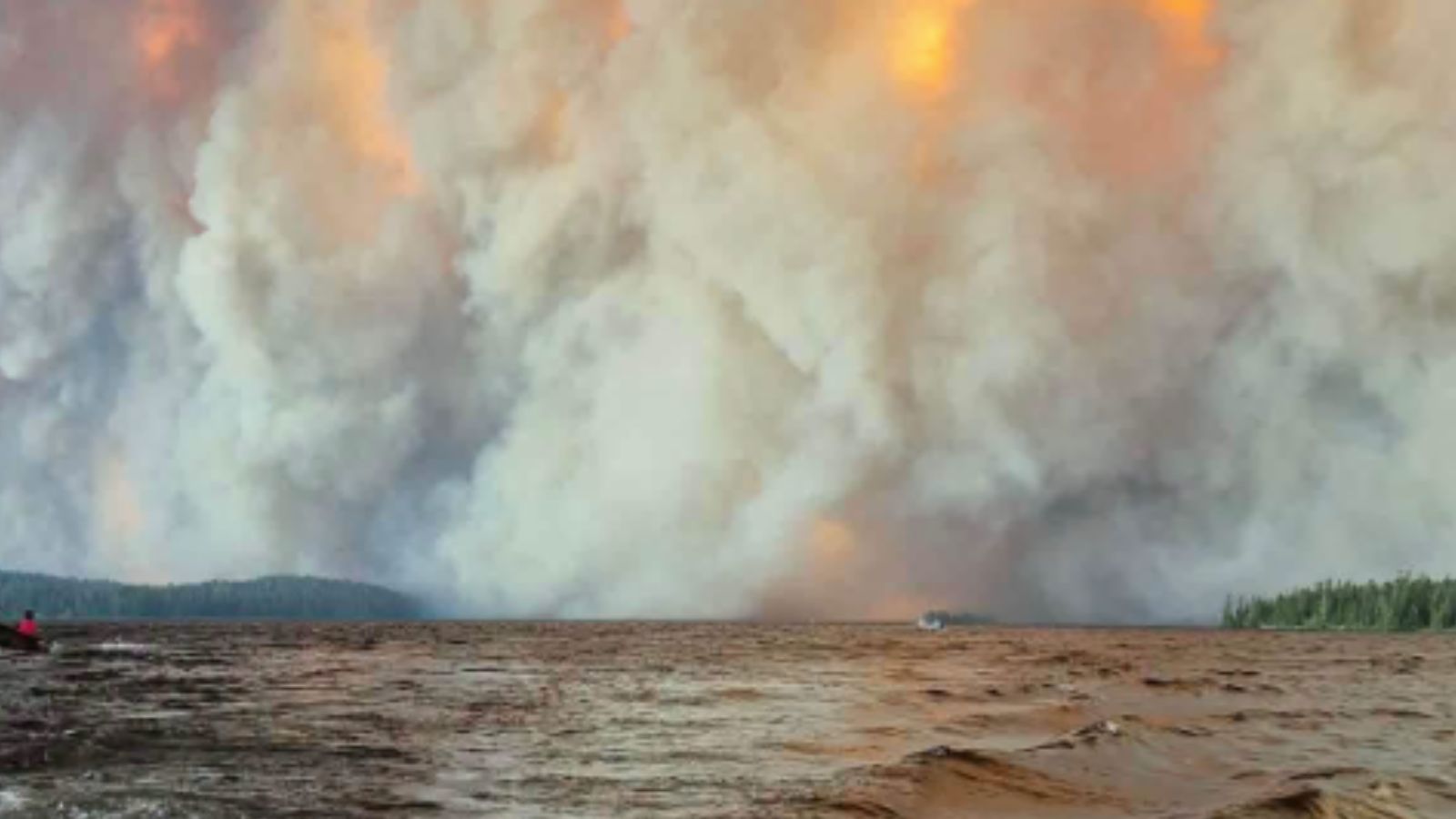
Currently, millions of acres of desiccated spruce, tamarack and birch are engulfed in the inferno that is the Canadian boreal forest. Maybe you’ve noticed, especially if you live in the northeast. It’s pretty bad this year but not an enormous departure from the trend of recent years.
“It’s really, really bad. It’s just so… I don’t know. I’m really worried about this. What are we doing to the planet now? I’m going to be ill.”
Hugh was enormously depressed by it all. I’d called to check in on my British friend and woodland fellow traveler, to make sure he wasn’t inhaling and to assure him that this is normal here in Pennsylvania: the skies become ashen about this season, things smell of maple leaf flambe´ and you find yourself wanting one of those N95 masks that seemed so popular a few years back. Hugh also holds to a certain set of politics which sees all environmental change as the fault of man, meaning that it all certainly needs to be rectified.
My first impulse was to point out that the year-upon-year fire menace of the Canadian forest was something managed by government – an ample and demonstrably ineffectual Canadian bureaucracy stewarding government lands. And a worsening conflagration is exactly what some of us expect from things managed by government. This is all in the hands of the Canadian forest fire bureaucracy. For those unfamiliar with this branch of true north’s permanent state, it’s kind of a make-work program for underemployed women with great sociology credentials, a smattering of ecology plaudits and winning stage presence. Again, some of us really expect these fires to worsen.
Yet, I’m determined not to take the low road today, striking at the obvious blunders of the Canadian aristocracy, kicking them while their country burns. I’d much rather talk about nature.
It’s likely that, if we’re forced to think about it, most of us, and especially Westerners, know that the aftermath of fire is renewal. The cones of certain conifers simply don’t open and disperse seeds without fire. A crowded understory sprouts again, starting its growth and primary production from zero. Sunlight reaches the forest floor in a way it hasn’t in a long time and the incumbent death of woody things releases a flush of nutrients, much of which ends up in the flowages draining these forests, stimulating invertebrate production. Most importantly, one of the finest edible mushrooms, the morel, proliferates in response to fire as one of the first signs of life, post-inferno. Incidentally, opportunities are opened for rock hounds and gold prospectors that would not be accessible in the pre-fire duff, scrub bushes and moss.
Forests that never burn might not be as idyllic as people want to imagine and forest managers today realize this. In the western United States, it’s become largely accepted that forests left to grow dense understories of tangled shrubberies and young trees become tinder boxes in which fires ignite more easily, spread more quickly and, importantly, burn more hotly, posing a greater menace to mature trees that might have survived passing fires otherwise.
In the bigger ecological picture though, fire is not an outlier, not something odd that doesn’t fit patterns seen elsewhere. Renewal brought about by cataclysm is hardly the exception, it’s the norm, integral to thinking right-headedly about our biome.
Fluvial flooding can be devastating, real horror story stuff, that scrapes Appalachian valleys bare and leaves no way of escape if valley inhabitants haven’t taken measures early. But it also, on an enormous scale, transports mountain forest nutrients and woody debris down to lower rivers and it radically re-routes flowages within their floodplains. Much would stagnate without this.
Trees fall regularly within a mature forest and, while it’s sad to see one of the big guys go down, its catastrophic departure opens a hole in the canopy for light penetration to up-and-coming trees. Fungi begin quickly to break the old-timers down (they were already working on their host trees before the fall) and we’ll have flushes of mushrooms shortly. As the trunks hollow with decay, homes are created for a community of animals from termites to bears.
If you’ve ever seen the aftermath of a tornado, where it tore through a forest with unimaginable shear and torsion, you’d probably be repulsed by the jumble of splintered oak, beech or pine. It’s not easily sauntered through. But return a few years later and you’ll find that this scar is now a green oasis apart from the monotonously dark shadow of the closed canopy all around. A wide variety of animals now choose this as a foraging site over the rest of the unperturbed woodland. (Utility rights-of-way can serve the same ecological purpose.)
Working on this piece, I’ve been rolling a fidget toy around in my fingers – just a rock I’m shaping and polishing right now. It’s not just any rock though, this is a piece of augen gneiss – arguably one of the oldest rocks on the planet. I found it where it had eroded out of a glacial deposit along lake Erie but it’s provenance was contemporaneous with the era in which cyano-bacteria ruled the planet, which is to say that this one was born at least a billion years before present. It’s hard, ornate and ancient. And it became what it is by passing through unimaginable cataclysms over unimaginable time: Volcanoes, mountain building, mountain destruction (of the ancient Laurentians), continental collision, glaciation, flood transport and all manner of grinding, collision, heat and pressure. This one has earned at least a good polish and a place on my shelf of awesomest rocks, if you’ll forgive the technical jargon.
Catalclysm is nature’s way, on short time scales and long.
And it’s not just one of the author’s many idle ruminations. It’s been institutionalized by evolutionary biologists as a key to “punctuated equilibrium,” which seems to mean that while evolution may proceed at a glacial pace through natural selection processes within stable environments, it’s the “disasters” that really shake things up, that really offer evolutionary opportunities for progress. Survival within radically upended environments forces creatures to adapt radically or die out.
Or maybe the evolutionary biologists borrowed the idea from 20th century economist Joseph Schumpeter. Schumpeter is credited with popularizing the idea of “Creative Destruction” which means all of the above pasted onto an economy instead of a forest. Schumpeter said, radically enough, that disasters and upheaval are not only aspects of a capitalist economy, they’re vital to its functioning. He went so far as to claim that Creative Destruction is the “essential fact about capitalism.” The cataclysms are features, not bugs and if the coercive power of government acts to protect existing technologies or industries, stagnation is guaranteed, progress is stunted. Which, by extension, may explain a great deal of the lackluster performance we witness in our own economy and maybe all of the lackluster performance of the British and Canadian economies.
“The essential point to grasp is that in dealing with capitalism we are dealing with an evolutionary process.”
-Joseph Schumpeter (Capitalism, Socialism, and Democracy)
In their best-selling 1997 work on the cycles of history, The Fourth Turning, authors William Strauss and Neil Howe claim that the fourth part of the century-long cycles of American history is a time of upheaval, disaster and peril in which old paradigms perish and new ideas that noone would have forecast a decade earlier, come to dominate. Their timing of things puts us right about in that “fourth turning” presently. And maybe we haven’t been thinking about things this way but destruction is happening all around us, in the political world and beyond, and its pace may be accelerating. The current wars in the Middle East and Ukraine are a good place to start with this devastation. The impending civil war in Great Britain is another. Closer to home, the far-reaching upheavals of the Trump years are another obvious example. COVID was hard to forget (and shouldn’t be forgotten). A lot of destruction, in myriad realms, is going to follow in the wake of AI implementation. Trust in institutions, for a full book’s worth of reasons, is historically low and falling. Strauss and Howe may have gotten this right.
But here’s the important thing about fourth turnings, ecological disasters and creative destruction: they precede a time of growth and opportunity we couldn’t have imagined in advance, rising from the ashes.
So, chin up, Hugh. Stay calm, carry on and let’s pay a visit to the charred northern wastelands next May for a nice basket of burn morels. Better days ahead and all that.
Free the People publishes opinion-based articles from contributing writers. The opinions and ideas expressed do not always reflect the opinions and ideas that Free the People endorses. We believe in free speech, and in providing a platform for open dialogue. Feel free to leave a comment.