
What Schools Owe Their Students
This screenshot from Reddit’s r/Teachers recently caught my attention:
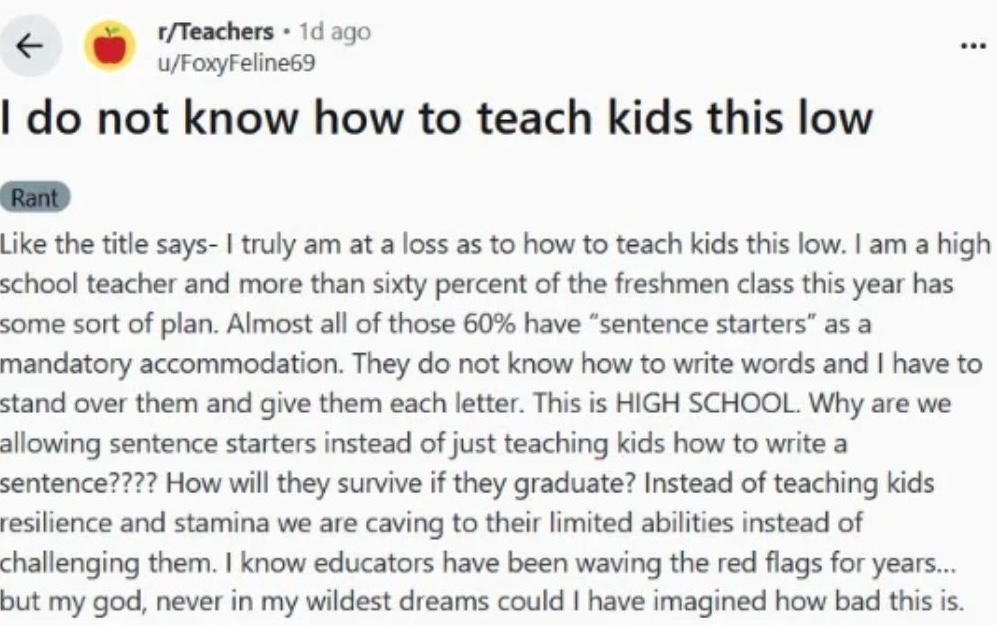
I can’t independently verify this specific account, of course, and one anonymous post cannot tell us what is happening in every school. But this is one of countless posts from teachers, administrators, and parents that you can find all across the internet making similar claims. What’s more, it directly aligns with academic studies, parental observations, survey data, and the test scores we see from K-12 education.
So regardless of the veracity of this particular story, the question it raises still deserves an answer:
Why are students reaching high school without the basic skills they need, and why does the system seem so willing to accommodate that failure rather than correct it?
My answer is that decades of ideological instruction within teachers’ colleges and the policies pushed by teachers unions have helped displace the actual work of education. The prime culprit, in my view, is the rise of explicitly Marxist-influenced “critical pedagogy”—or the idea that education should be organized around identifying oppression and transforming society, as opposed to being designed to teach students crucial skills like reading, writing, and arithmetic or building a strong foundation of empirical facts and logical reasoning.
That framework is not something critics simply invented. Vermont State University’s teaching center presents Freirean pedagogy as an approach whose goals include transforming structural oppression and whose role is fundamental to the revolutionary process. The National Education Association frequently hosts panel discussions for aspiring educators like defending critical race theory against what it describes as misinformation.
These are different intellectual traditions, and neither example establishes what every teacher believes or teaches. But they do show that the ideological frameworks I’m criticizing have an institutional home.
I regard the substitution of those frameworks for open inquiry and academic instruction as indoctrination. Too much of the education establishment seems to view the role of the teacher as correcting wrongthink and getting students to believe in its various shibboleths, rather than promoting curiosity, critical thinking, and a truth-seeking mindset.
Meanwhile, the research that is supposed to discipline educational practice has serious problems.
A 2014 study by Matthew Makel and Jonathan Plucker examined the publication histories of the 100 education journals with the highest five-year impact factors and found that only 0.13 percent of articles were replications. In other words, although teachers colleges talk a big game about providing professional expertise, almost no one in that field even attempts to check, challenge, or verify academic papers in pedagogy.
A later mapping review covering 2011–2020 found some improvement, with the annual proportion increasing from 0.13 percent to 0.27 percent. That is not evidence that every study fails replication. It is evidence that remarkably little of the published literature consists of attempts to check earlier findings. Given that painful lack of scientific review, it’s impossible to say with any confidence that any of the more recent trends in education have a shred of empirical support, and yet journalists and professors covering education often wildly overstate their field’s general competence.
If an academic discipline is going to tell millions of teachers how to teach millions of children, checking whether its findings hold up should be a bare minimum standard.
Instead, educators get possessed by various fads and manias: giving students more say in what they study and to what level of complexity, treating traditional instruction as inherently suspect, and approaching the literary canon as something to deconstruct rather than something worth knowing. My objection is to making ideological and demographic criteria a substitute for judgments about what students should learn.
There is research supporting the importance of instructional guidance, too.
In their 2006 review, Paul Kirschner, John Sweller, and Richard Clark argued that minimally guided instruction is generally less effective and less efficient than strong guidance for learners who lack substantial prior knowledge. That does not mean students should never explore or make choices. It means that giving them choices does not relieve adults of the obligation to teach them things.
The academic results should alarm us.
In the 2024 National Assessment of Educational Progress, 32 percent of twelfth-graders scored below NAEP Basic in reading, compared with 20 percent in 1992. In mathematics, 45 percent scored below NAEP Basic, compared with 40 percent in both 2005 and 2019. These categories are not a count of students who cannot read at all or perform any calculation. They are evidence of serious academic weakness among students approaching the end of high school.
My view is that an educational culture preoccupied with ideological formation has helped weaken its commitment to teaching the knowledge and skills students need, and that the rejection of traditional teaching methods such as phonics and rote memorization has been the final nail in the coffin.
When schools spend years teaching ideological obedience instead of math, reading and reading comprehension, science, history, and civics, we should not be surprised if some young people emerge with weak academic skills but absolute certainty that we should overthrow the “capitalist patriarchy” and institute a new Bolshevik Revolution in its place.
Our K-12 schools and our universities are rapidly churning out ideological activists who are extremely passionate about their cause, while also being maximally ignorant of the world around them and who know absolutely nothing about their society’s history, political institutions, or intellectual foundations.
Perhaps worse still, while that kind of indoctrination may work on the average student, there will also always be a subset of reactionary students who bristle at being told that America, white males, and boys in general are evil and useless and who ultimately reject that ideological frame without actually becoming better informed themselves. Those students seem highly susceptible to joining the “post-liberal,” pro-authoritarian crowd. They feel like they’re sticking it to the man by (correctly) rejecting their teachers’ terrible ideologies, but they still lack the knowledge needed to recognize the problems with another.
It’s all downstream of failing to teach kids things our ancestors would have thought pretty basic.
If you’re trying to raise a kid to be a responsible, productive member of society, what do they need to be able to do and understand?
- How to read and understand information presented to them in newspapers, books, online, and elsewhere.
- How to reason clearly and perform basic calculations so that they can understand things like time and money, and have the agency they need to build things, cook and bake things, and manage their own accounts and schedules. At a more advanced level, math also helps people navigate a world where people lie with statistics and deceive through omissions.
- How their government actually works: what its branches are, how they function, and why it was set up the way it was. Without this, people will flail around impotently and often bitterly, wondering why things are the way they are without having anyone to blame other than convenient scapegoats like “billionaires” or “immigrants.”
- What historical events and ideas led to the creation of their government and modern Western civilization. Without this, people become extremely prone to repeating the same mistakes. And no, Howard Zinn isn’t your guy if he is being offered as a substitute for a broad historical education.
- How to engage in discussion and debate without being hijacked by emotional outbursts. This is how we all grow and learn. It’s how we develop genuine empathy for other people and expand our sense of the world and who exists in it. Simply calling something “social-emotional learning” does not establish that it accomplishes this (and I’d strongly argue that SEL does not).
There’s more, but schools are too often failing to give students a solid grounding in even these essentials. In the 2022 NAEP assessments, 31 percent of eighth-graders scored below NAEP Basic in civics, and 40 percent scored below Basic in U.S. history. Neither figure was significantly different from its respective first assessment year, so these particular results describe a persistent weakness rather than a newly emerging collapse.
And when these subjects are taught through a critical theory lens, complex and nuanced issues can be collapsed and flattened into class, race, or gender-based power struggles.
I think this encourages a habit of mind in which “all art is political,” and people struggle to conceive of experiencing a story or an interaction with someone else without framing it around tribal or partisan ideological nonsense. It also makes it harder to develop consistent principles and judge people on their actions and ideas rather than things like their skin color or sex.
Between my eighth- and ninth-grade years, my school district eliminated advanced classes, describing the gifted program as “elitist.” In ninth and tenth grade, it significantly revised its reading list, removing a lot of classic literature to make room for modern, “award-winning” (but usually mediocre-at-best) writers because they were female or a member of some politically preferable minority group—although many of those authors were not American and actually were members of the majority population in their own countries, which made the demographic framing seem especially peculiar to me.
I’m describing my recollection, not quoting district records, but what stayed with me was the sense that academic challenge and literary merit were being subordinated to a different set of priorities.
In college, I took a multicultural education class through the education school where the professor framed everything in terms of race, gender, and power structures—and where we were explicitly asked to make assumptions about our classmates based on those traits. The theme of that class might as well have been: Think in stereotypes, and remember that a lot of people from rough backgrounds will struggle with things like literacy, so never challenge them or make them feel bad.
That’s what was being taught to future educators.
So here we are.
Students need help, and some need substantial accommodations. But those supports should help them acquire knowledge and independence. If we keep lowering our expectations until failure becomes something we merely manage, we are abandoning the very students we claim to be helping. Schools owe them an education that gives them the ability to read, reason, understand their world, and decide for themselves what to believe.
Free the People publishes opinion-based articles from contributing writers. The opinions and ideas expressed do not always reflect the opinions and ideas that Free the People endorses. We believe in free speech, and in providing a platform for open dialogue. Feel free to leave a comment.