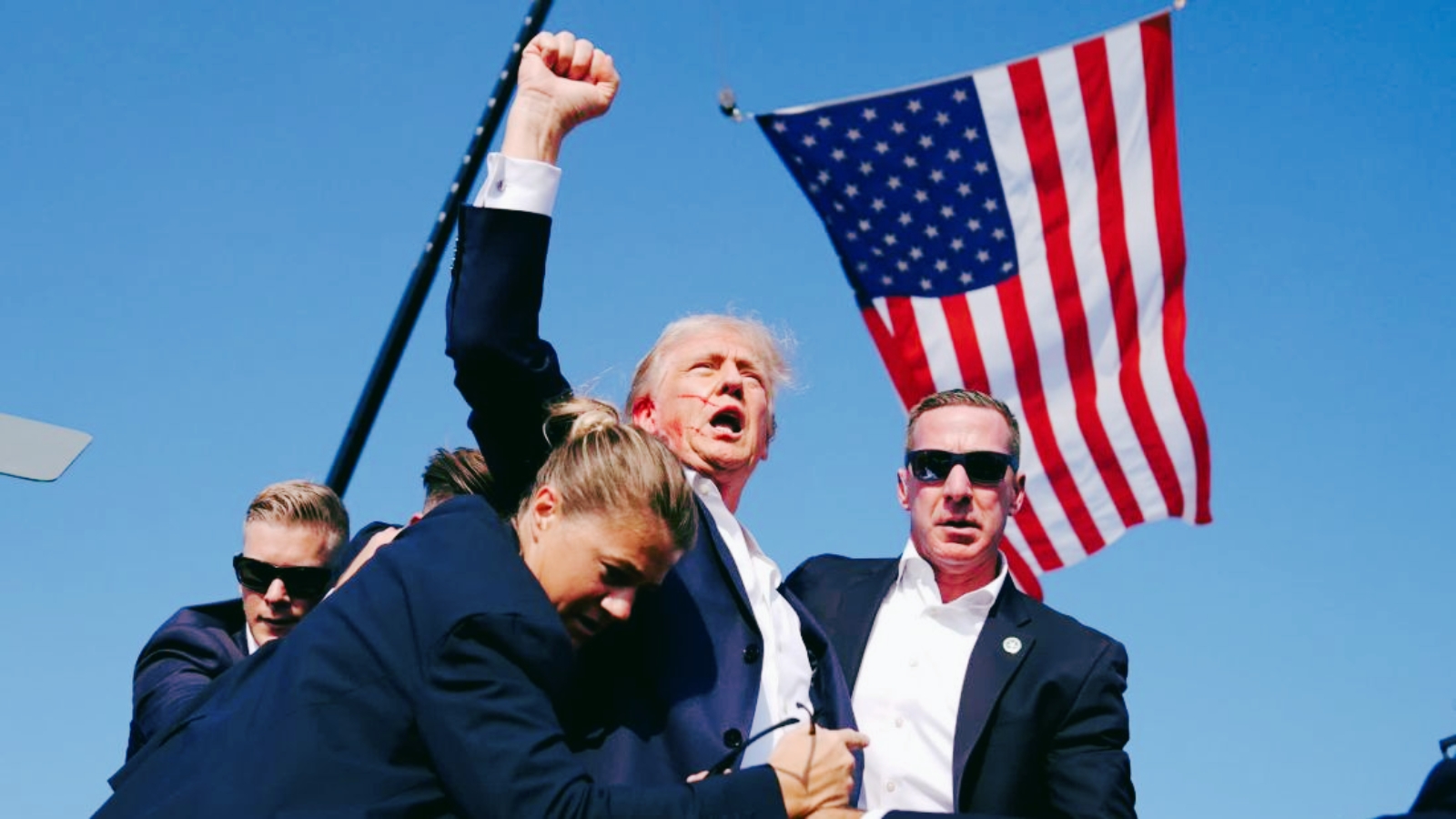
A Picture Worth a Thousand Votes
Trust Chris Caldwell’s deft hand to author the definitive commentary on the shot that won the 2024 election. And the supremo scribe wasn’t acclaiming the amphetaminic injection thrust into Joe Biden’s bony tush just before the infamous June debate, which he squandered in ol’ kook fashion anyway.
The failed sniping of Donald Trump in a Pennsylvania farm field a year ago revealed much about America, the most prominent facet being that even after decades of bungled foreign adventurism, neglectful husbanding of the global economy, and presiding over the destabilization of doux commerce, we guileless Yankees still catch a lucky break from the Great Divine. Who else but God would have compelled Trump to miraculously swivel his head toward an intern-designed PowerPoint slide in time to dodge a hurtling bullet? For all our shortcomings, the United States still enjoys propitious company with fools and drunkards.
Trump’s lobe-punch also demonstrated a quality rarely witnessed these levelled days. “Everything about it was at odds with the American postwar conception of leadership,” Caldwell observed. The “equal opportunity” ethic drummed ceaselessly into children’s brains starting in kindergarten has, in a practical manner, smoothed the gritty striations of hierarchy. The very idea of achievement over others is anathema to flatlined ranking. “Nothing could be more repugnant,” Caldwell elucidates on our egalitarian dispensation, “than the notion that leadership is something you either have or you don’t.”
What Trump displayed in those precious few seconds after being bullet-clipped, thrusting forth from ringing Secret Service agents, fist raised in bloody defiance, commanding his legions to “fight fight fight!”, was an innate and unteachable esse inextricable from his being. It wasn’t an Ivy League graduate course in pistol-dodging, nor a free LinkedIn certification in “How to Appear Confident in Stressful Situations.” Trump’s spur-of-the-moment flex and marshall just after his near-death was the kind of courageous arete seldom seen outside the cineplex. Emanuel Leutze and Jacques-Louis David could never hope to limn the Herculean stature Associated Press photographer Evan Vucci adventitiously snapped into a visual still.
In retrospect, psephologists should have called the election then and there. Melania Trump may as well have started measuring the White House drapes. The Democratic side had no recourse to challenge such a fervent meme seared into the American consciousness. Its official candidate acted more like an escapee of The Villages than a president; the hurried switcheroo to his affirmative-action deputy helped little. High heels, a dun pantsuit, and that ear-scrabbling laugh would never measure up to adrenalized brawn. Even if Kamala Harris was capable of articulating an argument for her election (a far-flung hypothesis), it would be pushing on a string. Semiotics sank the soapbox.
The triumph of symbol over substance isn’t hard to suss out when considering how widespread digitization has altered the manner by which we communicate. Political debate used to be the exchange of glib soundbites, occasionally garnished with a dash of wit. The rise of social media has concomitantly lowered the import of lexicology. Political campaigns have long operationalized aesthetics over wonkish details on subvention policies, starting with the first televised presidential debate between a sweaty, disgruntled Richard Nixon and a suave John F. Kennedy. A half-century on, Barack Obama won the presidency in a walk due to Shepard Fairey’s “Hope” portrait, which was a ubiquitous avatar on every white wine aunt’s Facebook page.
The country’s only become more byte-sized since 2007. We traffic expressions less with actual words, more with graphics, emojis, and GIFs. “It feels as if the whole world has been transformed into images of the world and has thus been drawn into the human realm, which now encompasses everything,” the Norwegian novelist Karl Ove Knausgård recently wrote in Harper’s. The JPEG-ing of life shouldn’t come as a ringing alarm. Much of our so-called “knowledge” economy seems to run on the trading of ZIP files stuffed with simulacra. We increasingly inhabit Edith Wharton’s “hieroglyphic world” where real things are never said but “only represented” by signs.
What is cause for concern is the rewiring our brains have undergone now that we’ve been dumped in a vat of bright, blinking pixels. Columnist Mary Harrington argues in the latest First Things issue that the printing press enabled deductive reasoning, while the silicon revolution has inspired more associative thinking. Reading a catena of sentences allowed us to cogitate in chained sequences. The “content overload” enabled by the digital infiniscape forces us to filter “less for linear logic than for latent patterns.”
Donald Trump may be a preening braggard who snakes Uncle Sam’s wallet to pay off Wall Street financiers and hoaxwash an international ephebophilia syndicate. But he’ll forever be emotionally cleaved to those ten seconds of ephiphantic bravery in the face of Mors. Such a deeply felt tie is not easily severed within the minds of millions.
The Democrats have yet to bottle their own viral lightning. Dozens of arrest flops in front of a waiting media scrum do little to dilute the force of a singularly captured act of sheer authenticity.
Free the People publishes opinion-based articles from contributing writers. The opinions and ideas expressed do not always reflect the opinions and ideas that Free the People endorses. We believe in free speech, and in providing a platform for open dialogue. Feel free to leave a comment.