

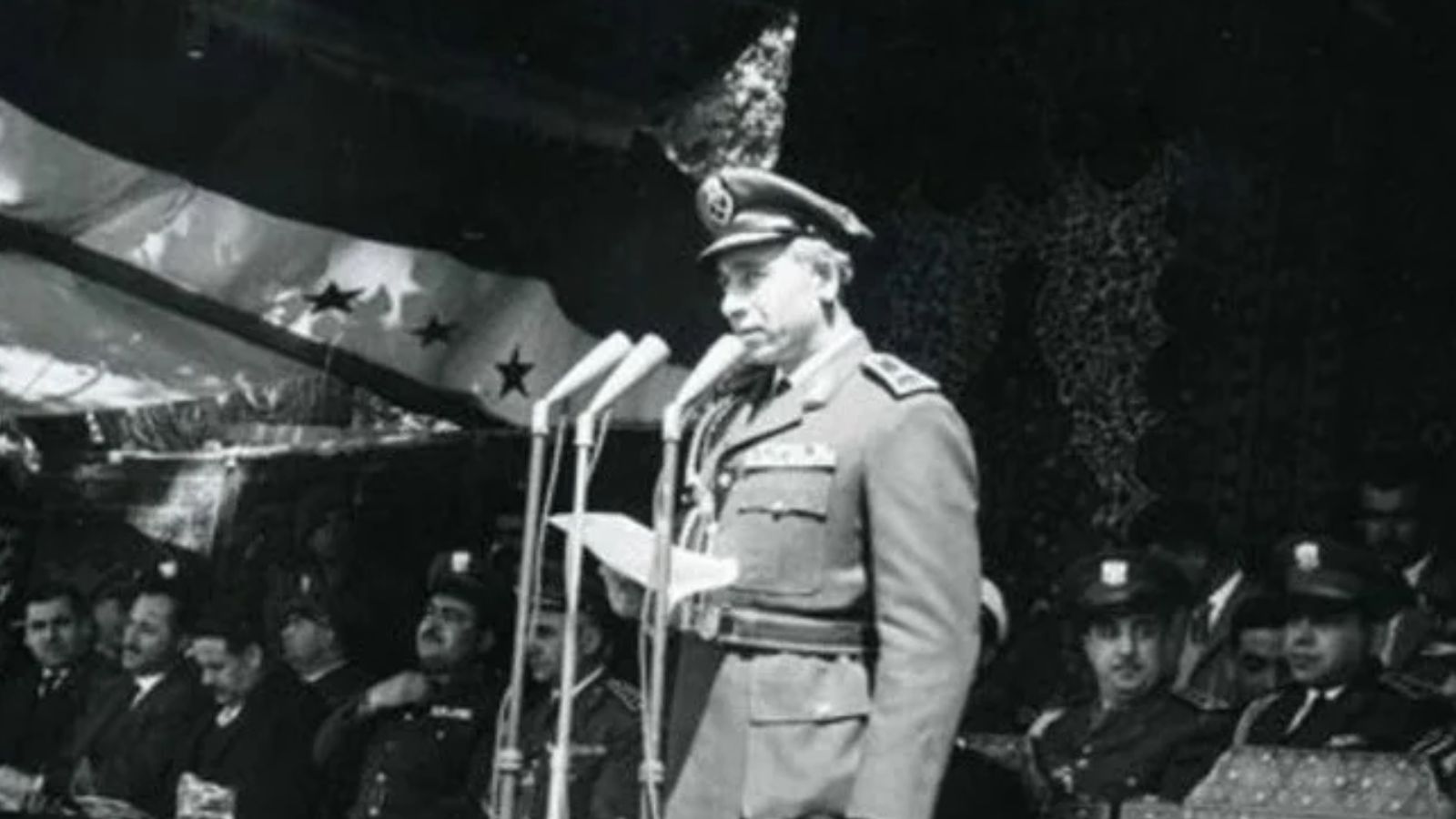
The Fascist Influence Within “Arab Socialism”
The interwar era through the mid-Twentieth Century saw fundamental changes in the political and intellectual life of Arabs. Disillusionment with Western liberal democracy due to the disintegration of the Ottoman Empire and the mandate rule imposed by the British and French powers had prompted political theorists and militant groups in the Middle East to find new models for liberation, social cohesion, and state modernization. In this context of anti-colonial resistance, European totalitarian regimes such as Italian Fascism and German Nazism were the source of keen interest among Arab nationalists. Nevertheless, Arab militant groups did not import any European doctrine, but did combine the fascist concept of discipline, vanguard, and youth militancy with anti-capitalist and anti-feudal economics.
The Historical and Political Climate of the Interwar Levant and Egypt
The intellectual birth of Arab political movements with fascist and socialist features happened in a particular colonial context. The dominance of Anglo-French powers within the framework of League of Nations mandates was interpreted by many intellectuals as a perpetuation of imperial plunder that had led to artificial fragmentation of the Arab domain. The failure of Western powers to create real democracy in Egypt, Syria, Lebanon, and Iraq, as well as the deepening crisis in Mandatory Palestine, made radical Arab intellectuals see Anglo-French parliamentary liberalism as corrupt, hypocritical, and inherently weak.
Many Arab intellectuals saw post-World War I Germany as sharing a similar fate with their region. Both were victims of Versailles peace terms and betrayal by Western imperial powers. This was why the rise of totalitarian state models in Europe was analyzed in the cities of Damascus, Beirut, Cairo, and Baghdad as possible signs on the road towards national revival, industrial modernization, and protection from imperialism. The efficiency of centralized state power, the elimination of factionalism within the nation, and militarization of youth were seen by Arab observers as crucial steps that were needed to overcome national decline.
Along with that, such movements developed an anti-capitalist orientation. Capitalism stood for imperial domination, foreign concessions, domestic merchant bourgeoisie, and feudal agrarianism. To form the broader pan-Islamic community (umma), Arab radical thinkers believed that economic exploitation of laissez faire had to be overcome through socio-economic planning.
The Syrian Social Nationalist Party (SSNP) and Antoun Saadeh: Socio-Economic Organicism
Some of the earliest examples of Arab movements that have combined fascist organizational forms and anti-capitalist ideology include the Syrian Social Nationalist Party (SSNP). The SSNP was secretly founded in 1932 in Beirut by Antoun Saadeh, a Lebanese Orthodox Christian intellectual. Unlike the other Arab nationalist movements, the SSNP opposed pan-Arabism and promoted pan-Syrian nationalism. This included the formation of a unified “Natural Syria,” which covered the Levant, the Fertile Crescent, Cyprus, and Sinai.
The SSNP chose structural attributes that were often likened to those of European fascist groups:
- The Leader Principle and Personalism: Saadeh was appointed as the party’s “Leader for Life,” creating an organizational hierarchy dominated by his leadership.
- Paramilitarism and Symbols: The SSNP used a unique symbol in the form of a four-bladed hurricane design known as the Zawbaa (signifying speed, power, and revolution), adhered to strict organizational secrecy, and maintained a paramilitary spirit among its cadres.
- Organic Secularism: Saadeh strove to overcome religious sectarianism, which he considered one of the causes of national decay, through the creation of a new secular nation founded on geography and socio-economic interaction.
The Ba’ath Movement: From Völkisch Roots to “Arab Socialism”
The formation of the Ba’ath party (“the Arab Resurrection party”) is the single most significant fusion of radical nationalism, authoritarianism, and anti-capitalist socialism in the history of the Arab world. Ba’athist ideology was formed in Damascus in the late 1930s and 1940s, thanks to the work of individuals like Zaki al-Arsuzi, Michel Aflaq, and Salah al-Din al-Bitar.
The intellectual origins of early Ba’athism were steeped in European nationalistic philosophies. Zaki al-Arsuzi, the founder of the League of Nationalist Action in 1933 and the Arab Ba’ath in 1940, he himself an Alawite philosopher trained at the Sorbonne, was influenced deeply by the Addresses to the German Nation of Johann Gottlieb Fichte, the work of Friedrich Nietzsche, the philosophy of Oswald Spengler, and romantic theories of national rebirth in the language and culture. Arsuzi maintained that the resurrection of the spirit of the Arab nation depended on cleansing the influence of foreign elements and reviving the pure language of Arabic as the natural tie that binds the nation.
In his book Al-Ba’ath, Sami al-Jundi, an early activist in Ba’athism and associate of Arsuzi, offers a description of the intellectual atmosphere in Damascus in the late 1930s and early 1940s. He recognizes the interest of the early Ba’athist movement in racist and fascist ideas:
“We were racialists, admiring Nazism, reading its books and the sources of its ideas – particularly Nietzsche’s Thus Spoke Zarathustra, Fichte’s Addresses to the German Nation, H.S. Chamberlain’s The Foundations of the Nineteenth Century, and Darré’s The Race. We were the first to think of translating [Hitler’s] Mein Kampf.”
But Jundi makes it clear that although the early militants drew inspiration from the power of the state and anti-imperialist strength of Nazi Germany, soon after, Ba’athism became an ideology all its own.
As founders of the Arab Ba’ath Movement, Michel Aflaq and Salah al-Din al-Bitar officially formulated its slogan-triad “Unity, Liberty, Socialism” (Waḥda, Ḥurriyya, Ishtirākiyya).
For Aflaq, Arab Socialism was quite different from Western Marxism and European social democracy:
- Refusal to Dialectical Materialism: While admitting the importance of the economic aspect, he denied the doctrine of dialectical materialism and atheism preached by Marx, insisting on the necessity for socialism to respect the spiritual genius of the Arab tradition and Islam.
- Anti-Capitalist Transformation: Socialism should be perceived not only as the economic redistribution, but also as a moral factor aimed at liberation of the Arab individual from the feudal oppression, bourgeois exploitation, and foreign economic interference.
- Leadership of the Vanguard: Being influenced by the organizational practices of Marxist-Leninist parties and the concept of the state, the founders of the Ba’ath stressed the need of having a vanguard party which would lead the Arab masses through the process of revolution.
The anti-capitalist trend of Ba’athism got a substantial radicalization in 1952 when the party of Aflaq and Bitar united with the Arab Socialist Party founded by Akram al-Hawrani. This way, Ba’athism built a militant agrarian base of peasants who were engaged in a struggle with feudal landlords of central Syria.
Paramilitary Shirt Movements and Youth Organizations
The combination of radical nationalism, anti-liberalism, and social reform under the auspices of the state government found great resonance among the youth movements in the Middle East in the 1930s. These youth movements modeled their ranks on the militarized paramilitary examples of Europe.
The Arab intellectuals such as Kazim al-Sulh (the editor of the Lebanese daily newspaper Al-Nida’) and Karim Thabit made direct references to the German and Italian youth policy, saying that it was necessary to conduct disciplined physical exercises and military formations for the modernization of the society and training the youth that would be able to stand up for its national independence against the colonial army.
This anti-liberal ideology was also characteristic for the first Islamists. The Muslim Brotherhood was established by Hassan al-Banna in Egypt in 1928. Its rapid growth took place in 1936-1939 at the time of the Palestinian revolt; its membership grew from 800 people to 200,000 people in 1938. Although Banna did not accept non-Muslim supreme power, the Muslim Brotherhood included paramilitary formations (Secret Apparatus), critique of capitalism as the dominant economy in the West, and the rejection of the liberal parliamentarianism.
Historiographical Perspectives: Realpolitik vs. Ideological Affinity
There is still no common consensus among modern historians about the definition of fascism (national socialism) in anti-capitalist Arab movements. According to historians such as Basheer M. Nafi, the cooperation of Arabs with the Axis powers during the interwar period was purely political and pragmatic (Realpolitik). Arab nationalists needed a European rival to fight the British and French empires (“enemy of my enemy is my friend”) and not a reflection of their ideological sympathies towards Nazism/Fascism. On the contrary, historians such as Götz Nordbruch claim that the Arabs’ interest in Europe’s authoritarianism was more serious than a simple pragmatic interest. Arab thinkers studied European discussions on state power, youth organizations, and reforms to solve contemporary problems of political stability and local modernization. Matthias Küntzel highlights the ideological connection between Nazi propaganda (Radio Zeesen broadcasting, for example) and radical Arab/Islamic groups. The theories of European anti-Semitism and anti-liberal totalitarianism were transferred into the Middle East before the establishment of Israel as a state.
In Sum
Fascist-inspired Arab movements of the interwar and mid-Twentieth Century, which combined the elements of fascism with anti-capitalist and socialist ideals, were complicated results of an anti-colonial revolution. Movements such as the SSNP by Antoun Saadeh and the Ba’ath Party of Michel Aflaq and Zaki al-Arsuzi blended totalitarian authority, vanguard spirit, and organic nationalism with an anti-feudal and anti-capitalist economic program. Similar to how Prussian Socialism of Oswald Spengler evolved from Marxism to become a form of fascism, anti-liberal, anti-capitalist, and anti-enlightenment values, the same can be said about Arab nationalism of such movements.
Free the People publishes opinion-based articles from contributing writers. The opinions and ideas expressed do not always reflect the opinions and ideas that Free the People endorses. We believe in free speech, and in providing a platform for open dialogue. Feel free to leave a comment.